
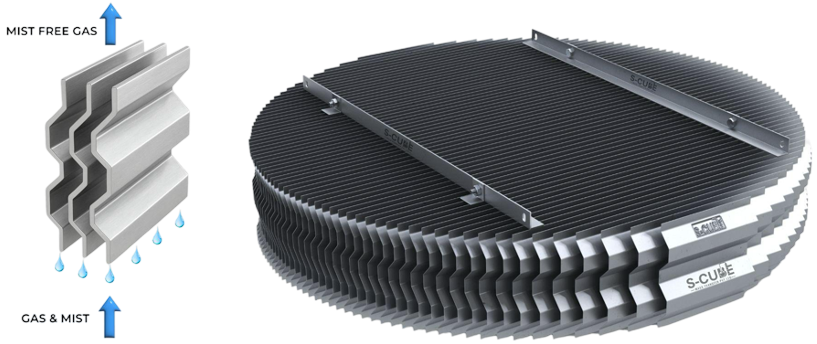
S-Cube Mass Transfer Pvt. Ltd. specialized in the design and manufacture of vane-type mist eliminators, also known as vane demister pads. These devices are engineered to efficiently remove entrained liquid droplets from gas streams, ensuring optimal performance in various industrial applications.
S-Cube mesh demisters consist of a pad of knitted metal or plastic wire mesh, usually sandwiched between grids for mechanical support.
Design and Operation: The vane-type mist eliminator consists of a series of angled vanes that create multiple directional changes for the vapor flow. As the vapor navigates through these bends, liquid droplets are forced to coalesce on the vane surfaces and subsequently drain away, effectively separating them from the gas stream.
Low Pressure Drop: The design ensures minimal resistance to gas flow, resulting in a low-pressure drop across the eliminator.
Resistance to Fouling: The configuration of the vanes allows for effective handling of processes prone to fouling, maintaining performance over extended periods.
High Vapor Capacity: Vane mist eliminators are capable of managing high vapor loads, making them suitable for demanding industrial environments.
Handling High Liquid Loads: These eliminators are effective in applications involving significant liquid content, ensuring efficient separation without compromising performance.
Applications of Vane-type Mist Eliminators
Oil and Gas
Chemical Processing
Flue Gas Desulfurization
Sulfuric Acid Plants
Chemical Process Industries – Removes mist from absorption, stripping, and distillation columns to improve process efficiency and product purity.
Desalination Plants – Removes saltwater droplets from vapor, ensuring high-purity freshwater production.
HVAC & Ventilation Systems – Controls moisture and prevents water droplet formation in air handling units.
Enhancing Glycol Dehydration Efficiency with S-Cube's Advanced Mist Eliminator Technology
S-Cube has engineered an advanced two-layer mist eliminator designed to significantly reduce glycol carryover in dehydration columns during gas compression and export processes. Glycol entrainment presents a critical challenge in offshore operations, leading to substantial economic losses and operational inefficiencies.
Traditional industry standards permit a maximum of 0.1 US gallons of glycol per MMSCF of gas, but this threshold has proven inadequate in minimizing glycol losses effectively. S-Cube’s innovative two-layer mist eliminator optimizes droplet capture efficiency, preventing excessive glycol losses while ensuring superior gas dehydration performance.
By integrating S-Cube’s advanced mist eliminator technology, operators can enhance glycol recovery, improve process reliability, and reduce operational costs, making it a robust solution for modern gas processing facilities.
Types of Vane Pack Mist Eliminators
VV Type Vane Pack (SCM–VV) Plain
Design:
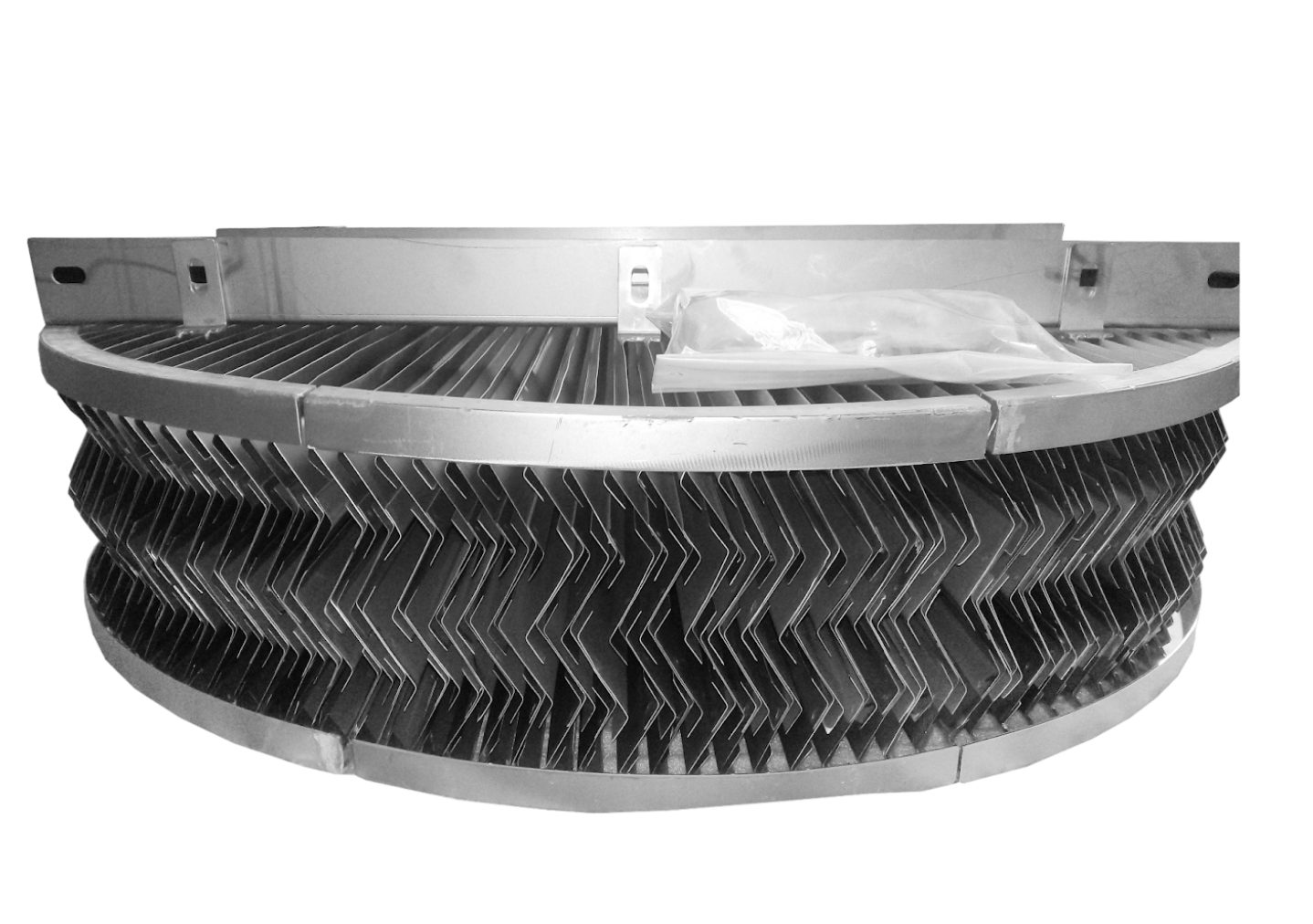
The Plain V-V Type Mist Eliminator consists of multiple V-shaped vanes arranged in parallel within a frame. As the gas stream flows through the vanes, liquid droplets are forced to change direction multiple times, leading to droplet capture and removal.
Advantages:
- Efficient Mist Removal – Effectively removes medium-to-large droplets (≥8–10 microns) from gas streams.
- Low Pressure Drop – Ensures minimal resistance to gas flow, improving energy efficiency.
- Self-Draining Design – Prevents liquid re-entrainment by allowing droplets to drain smoothly.
- Versatility in Flow Orientation - Double-hook vane packs can be utilized in both horizontal and vertical flow configurations, offering flexibility to suit various process requirements.
- High Durability – Made from materials like Stainless steel, Nickel based alloy, Titanium, Carbon steel, Polypropylene, Other special materials available on request.
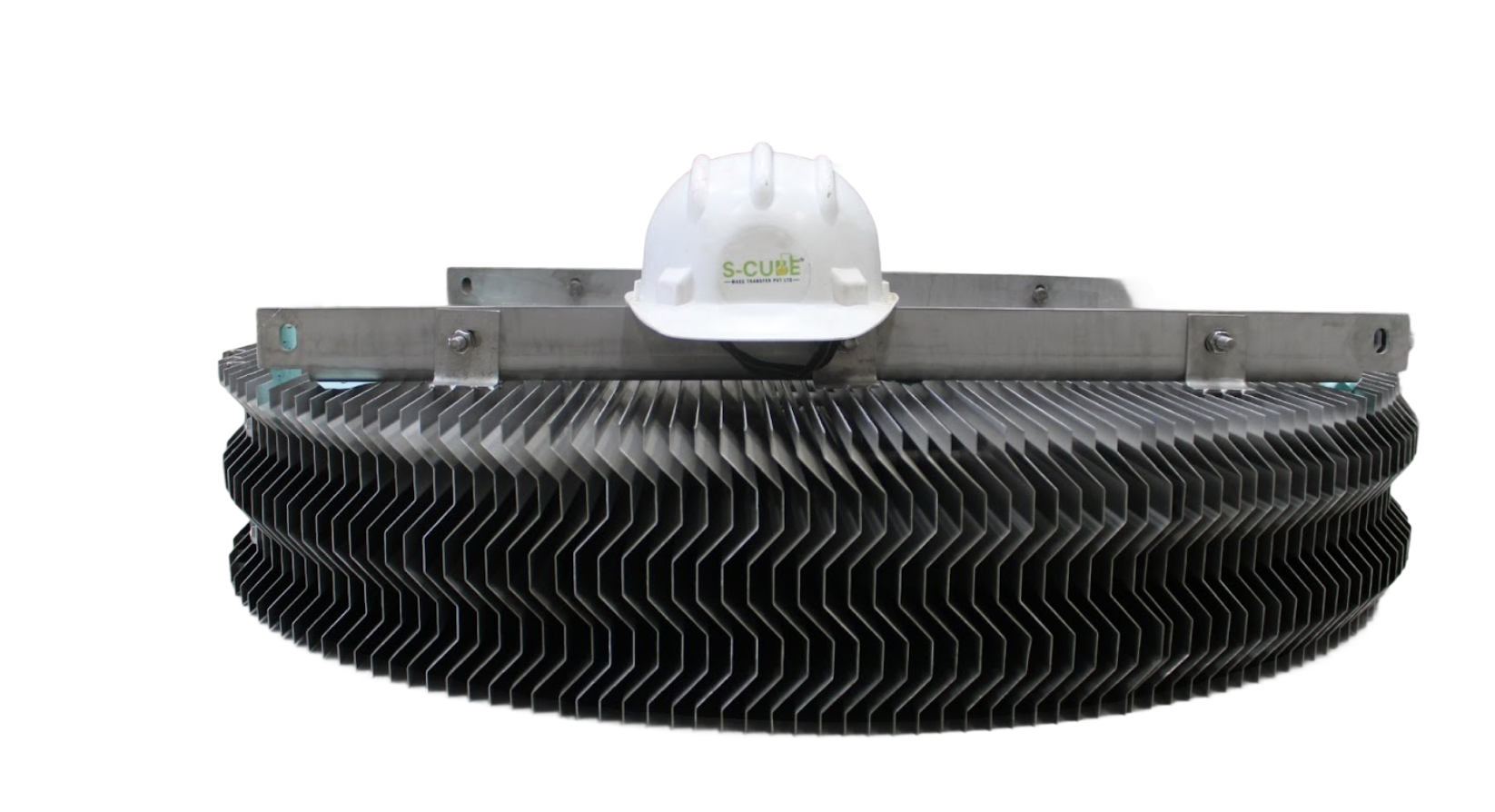
Single-Hook Vane Pack (SCM–VH1)
Design:
- Features one hooked bend in the vane profile.
- The hook helps in capturing and draining liquid droplets while allowing gas to pass through.
- Commonly used in applications with moderate liquid loads and relatively clean gas streams.
Advantages:
- High Separation Efficiency - The hooked vane design effectively captures and drains coalesced liquid, preventing re-entrainment and ensuring efficient droplet removal.
- Resistance to Fouling - The SCM-VH1's design allows it to handle high liquid loads and fouling services effectively, making it suitable for applications with significant particulate content.
- Low Pressure Drop - Engineered to maintain minimal pressure loss, the SCM-VH1 ensures energy efficiency and optimal process performance.
- Versatility in Flow Orientation - Double-hook vane packs can be utilized in both horizontal and vertical flow configurations, offering flexibility to suit various process requirements.
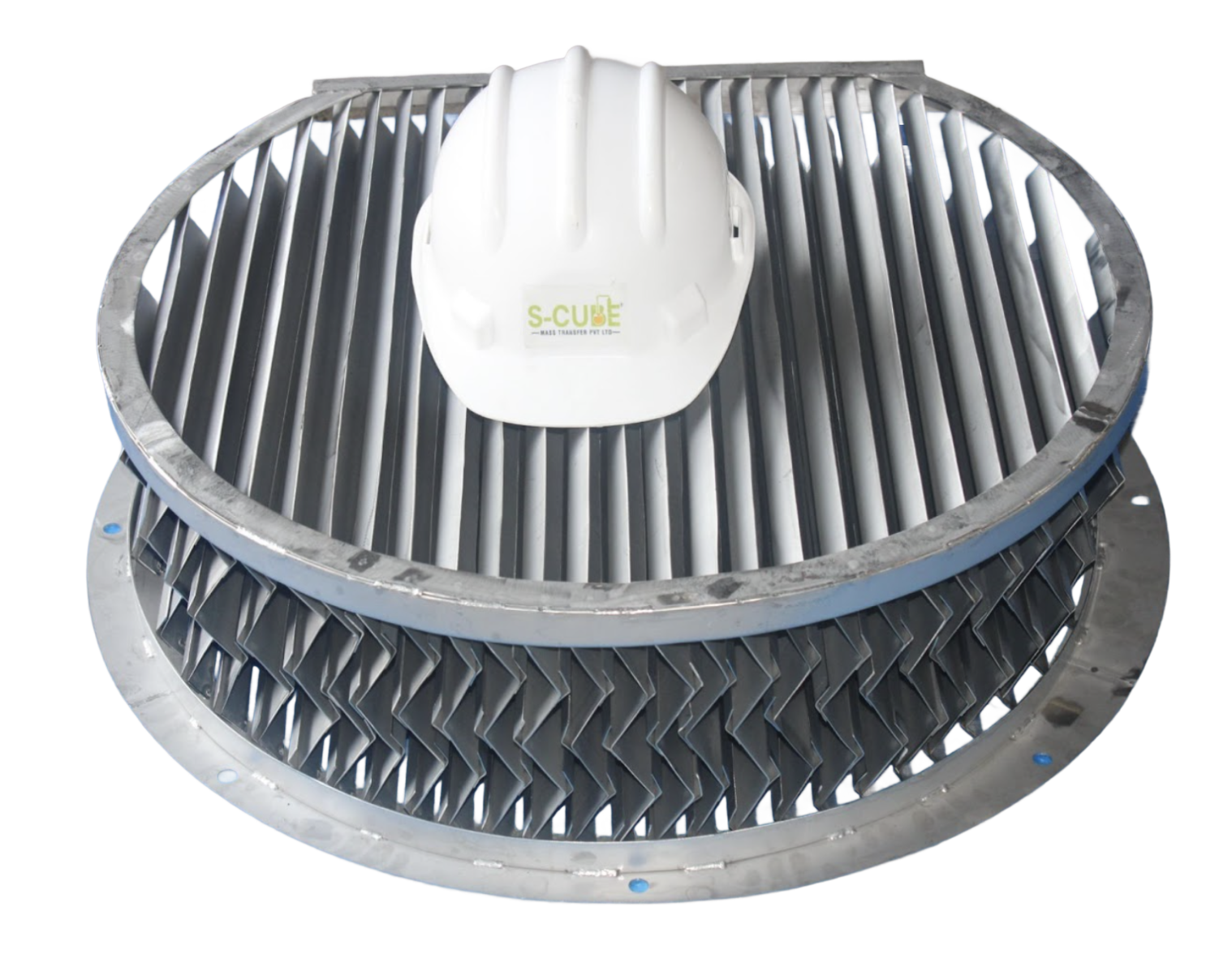
Double-Hook Vane Pack (SCM- VH2)
Design:
- Features two hooked bends in the vane profile.
- The additional hook increases separation efficiency, forcing droplets to coalesce and drain out.
- Ideal for high liquid loads and heavily contaminated gas streams.
- Generally suitable for horizontal gas flow.
Advantages:
- Enhanced Liquid Drainage - The double-hook design creates internal channels that guide coalesced liquid away from the gas flow, reducing the risk of re-entrainment and ensuring efficient separation.
- High Separation Efficiency - By providing multiple directional changes, these vane packs effectively capture fine mist particles, improving overall separation performance.
- High Capacity Compared to VH1 & VV -The SCM-VH2 vane pack offers a significantly higher capacity for separation compared to the VH1 and VV models, making it more effective for larger-scale applications and increasing overall process efficiency.
FAQs
S-Cube offers three main types: VV Type Vane Pack (SCM–VV) Plain, Single-Hook Vane Pack (SCM–VH1), and Double-Hook Vane Pack (SCM-VH2). Each type is designed for specific applications and liquid load conditions, with the double-hook version offering the highest capacity and separation efficiency.
Vane Pack Mist Eliminators can be manufactured from various materials including Stainless steel, Nickel-based alloys, Titanium, Carbon steel, Polypropylene, and other special materials available on request. The material selection depends on the specific application requirements, operating conditions, and chemical compatibility.
Vane Pack Mist Eliminators effectively remove medium-to-large droplets (≥8–10 microns) from gas streams. The separation efficiency depends on the specific vane design, with double-hook vane packs offering enhanced performance for fine mist particles.
Yes, Vane Pack Mist Eliminators are specifically designed to handle high liquid loads effectively. The double-hook design (SCM-VH2) is particularly suitable for applications with significant liquid content, offering enhanced liquid drainage and preventing re-entrainment.
Vane Pack Mist Eliminators are engineered to maintain minimal pressure loss, ensuring energy efficiency and optimal process performance. The low-pressure drop design is one of the key advantages of vane-type mist eliminators compared to other separation technologies.
Vane Pack Mist Eliminators are widely used in Oil and Gas refineries, Chemical Processing industries, Flue Gas Desulfurization systems, Sulfuric Acid Plants, Power Plants, Desalination Plants, and HVAC & Ventilation Systems. They are essential for preventing liquid carryover and ensuring smooth operation of downstream equipment.
Still have questions?
Can't find the answer you're looking for? Please chat to our friendly team.