
S-Cube Mist Eliminators
Efficient Liquid Droplet Removal Solutions
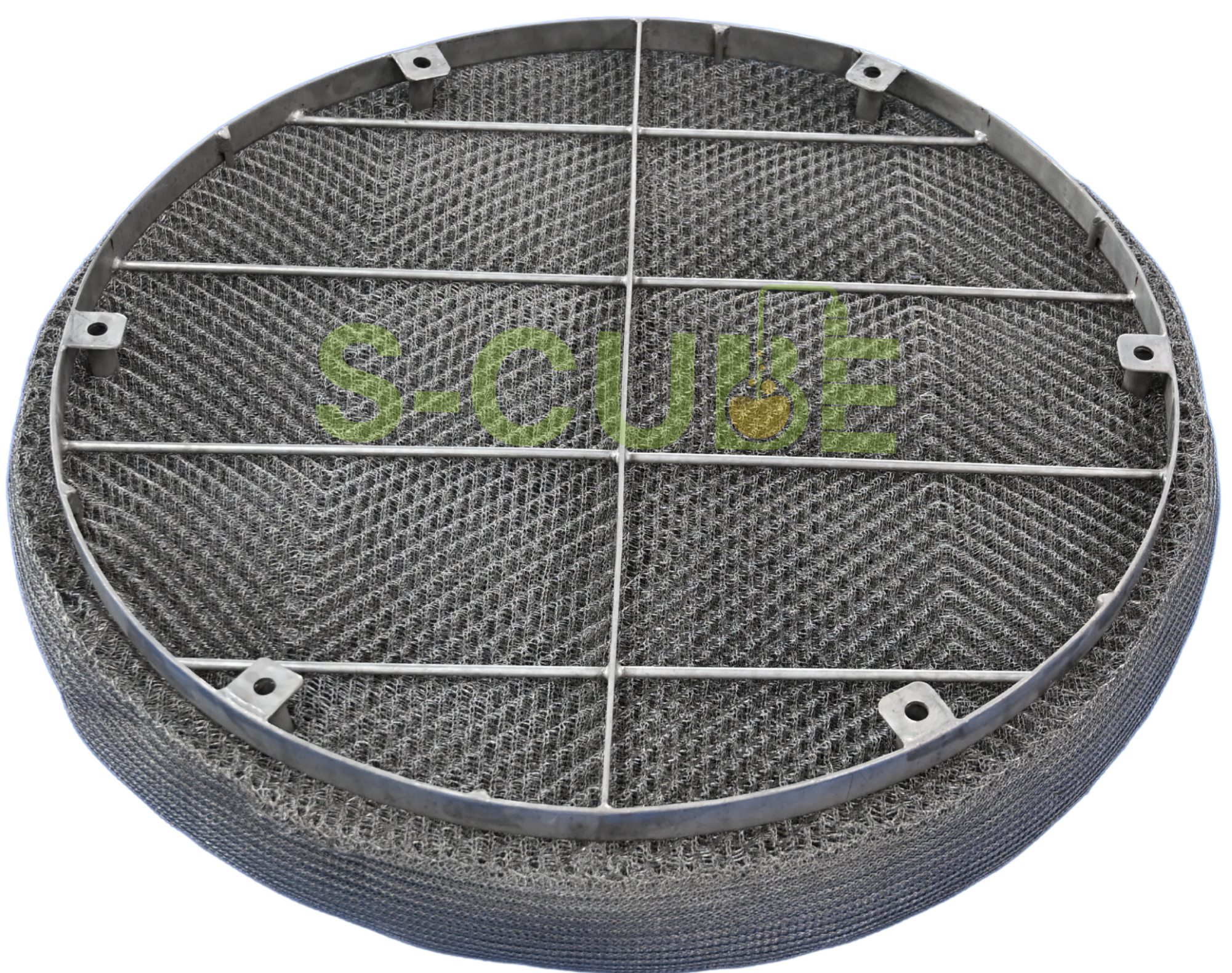
In many industrial processes, mist elimination is crucial for ensuring efficiency, protecting equipment, and reducing emissions. In such cases, mist eliminators play a vital role by helping to remove entrained liquid droplets from gas and vapor streams, preventing product loss, environmental contamination, and system inefficiencies.
At S-Cube Mass Transfer Pvt. Ltd., we offer advanced mist eliminator solutions that significantly reduce liquid carryover, lower pressure drop, and increase operational capacity. Unlike standard solutions, our engineered mist eliminators improve performance by up to 100 times, enhancing system efficiency and reducing costs.
Mist eliminators are designed to remove liquid droplets from gas streams to ensure cleaner emissions and protect downstream equipment. The effectiveness depends on several mechanisms that capture and separate droplets based on their size and motion.
1. Diffusional Deposition (Random Collision Capture)
- Works best for very tiny droplets (smaller than 1 micron).
- These droplets move randomly (like dust floating in sunlight) and bump into surfaces inside the mist eliminator.
- When they hit a surface, they stick to it, preventing them from escaping with the gas.
2. Direct Interception (Pathway Capture)
- Helps remove small to medium-sized droplets.
- Droplets travel along with the gas flow and come into contact with obstacles like mesh or vanes.
- Once they touch the surface, they stick and drain away, removing them from the gas stream.
3. Inertial Interception (Momentum Capture)
- Targets larger, heavier droplets.
- Just like a car struggling to turn quickly at high speed, these droplets cannot follow sharp bends in the gas flow.
- Instead, their momentum causes them to collide with eliminator surfaces, separating them from the gas.
4. Gravitational Deposition (Settling Capture)
- Works for large, slow-moving droplets.
- Similar to raindrops falling, these droplets are pulled down naturally by gravity and separate from the gas.
- This method is effective in low-speed gas flows but requires a lot of space, making it less practical for high-speed operations.
Applications of Mist Eliminators
- Scrubbing, Absorption & Distillation Towers
- Evaporators & Falling Film Condensers
- Sedimentation Vessels & Tri-Phase Separators
- Desalination Plants
- Cooling Systems & Gas Dehydration Plants
- Compression & Gas Moisture Removal Mechanisms
- Oil and Gas Industry
- Process Industry
- Flue Gas Desulphurization
- Sulphuric Acid Plants
Types of Mist Eliminators We Offer
S-Cube Wire Mesh Mist Eliminators
(SCM Mesh Pad)
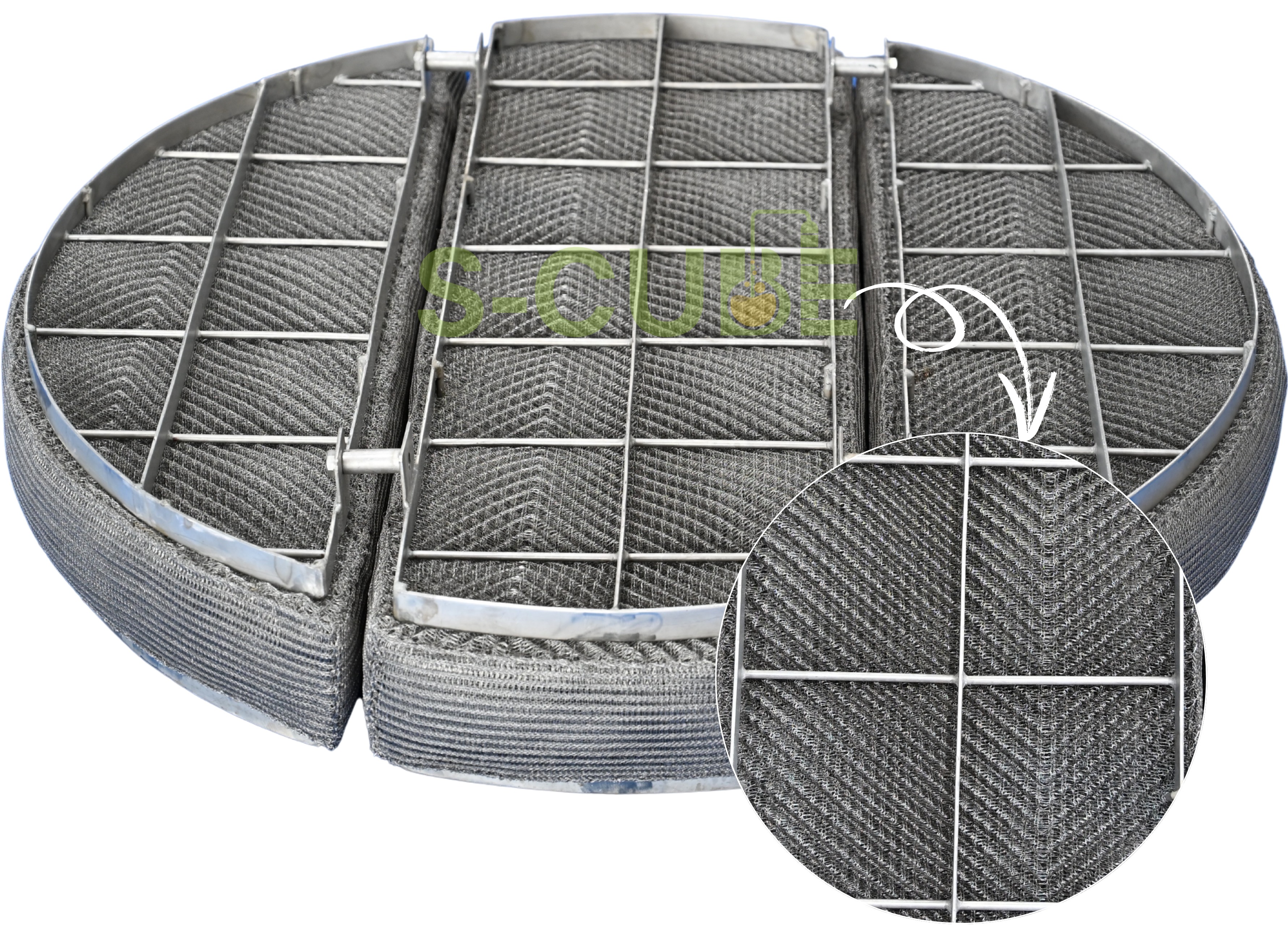
Designed to capture and remove fine liquid droplets from vapor streams. It consists of a knitted wire mesh structure, providing a large surface area for droplets to collide and coalesce, ensuring cleaner vapor with minimal pressure drop.
Vane Pack Mist Eliminators
(SCM Chevron – V Shaped)
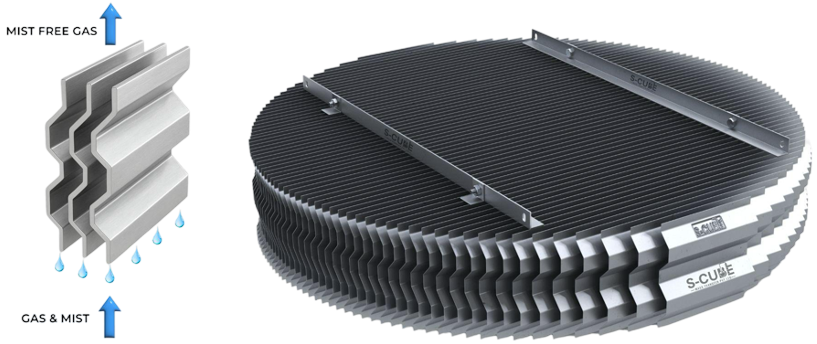
Engineered to efficiently remove entrained liquid droplets from gas streams using angled vanes that create multiple directional changes, forcing droplets to coalesce and drain away for optimal separation performance.
FAQs
Mist eliminators can be made from various materials including metal mesh, plastic, fiberglass, or specialized alloys depending on the application requirements, operating conditions, and chemical compatibility needs.
Mist eliminators work through several mechanisms including diffusional deposition, direct interception, inertial interception, and gravitational deposition. These mechanisms capture droplets of different sizes as the gas stream passes through the eliminator media.
The size of a mist eliminator depends on the vessel diameter, gas flow rate, and required efficiency. They can be custom-designed to fit specific vessel dimensions and process requirements.
Still have questions?
Can't find the answer you're looking for? Please chat to our friendly team.