
Non-metallic Structured Packing
For Corrosive Applications
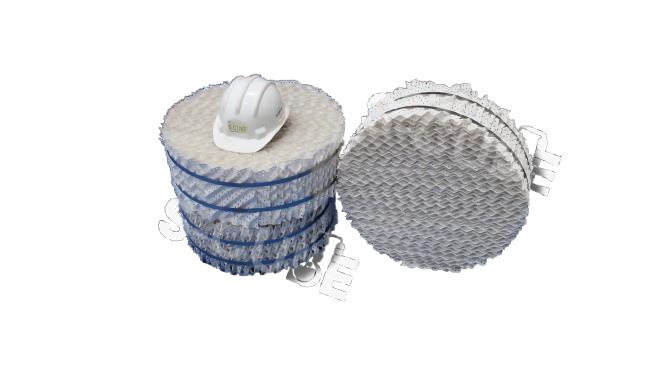
This packing forms a thin liquid layer on a ceramic surface, facilitating low-pressure mixing of liquid and vapor. It highlights its mass transfer efficiency, superior corrosion and temperature resistance compared to metal packings, and its ability to encourage wetting, minimize liquid hold-up, and reduce overheating, polymerization, and coking. Specific applications listed include deaerators, flue gas coolers, HCL absorbers, and CL2/SIO2 scrubbers.
Excellent Features
- Excellent surface wetting ability, larger mass transfer area, and higher separation efficiency owing to the special surface structure;
- High compressive strength;
- Little magnifying effect;
- More fields/conditions to be applicable
| S-Cube Structured Packing | Surface Area (SQ.M./CU.m.) | F-Factor | No. of Theoretical Stages Per Meter HL(NTSM) |
|---|---|---|---|
| 250Y | 250 | 2.5 | 2.5 |
| 350Y | 350 | 2 | 3.5 |
| 500Y | 500 | 1.6 | 4.5 |
Applications
- Distillations and Absorption of strong corrosive mixtures
- Distillation of halogenated organic components
S-CUBE plastic structured packing have the high mass transfer efficiency as metal packings, more resistant to corrosion and low temperature.
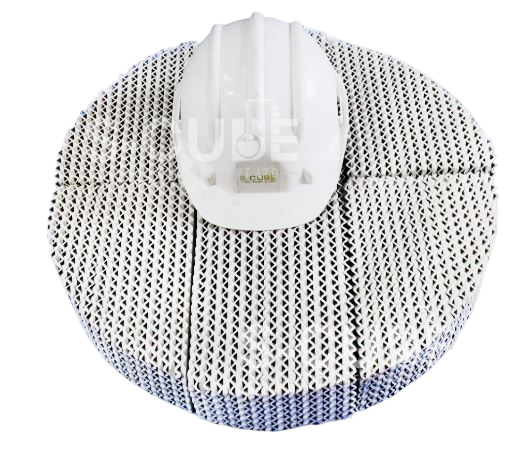
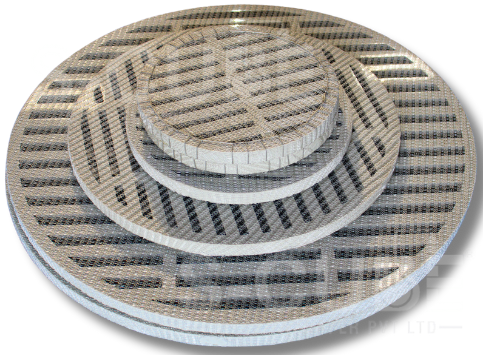
PTFE/PP Structured Packing is used for corrosive applications. It consists of a thin corrugated sheet arranged to create a large surface area.
PTFE/PP structured packing is used as a replacement for the cerams saddle. It has high durability and more stages.
- It is a completely chemically inert material
- It is strong but light in weight
- It gives rise to the adequate area for both Gas & Liquid
- Streams without excessive liquid hold up and less pressure drop
- It provides good contact between liquid and gas
- It is washable and reusable It is unbreakable too
- It is energy conserving
Enhanced Features
- High transfer unit count for each meter with a reduced HTU, varying based on the system.
- Minimal pressure reduction for every meter of packed height.
- Cost-effective load range reaching up to an F factor of 3 Pa.
Optimal Operating Temperatures
- Roughly 80-100°C for polypropylene.
- Approximately 120-150°C for PTFE.
Application Areas
- HCI absorbers
- SO2 absorbers
- Flue gas cleaning columns
- Sea water deaerators
FAQs
Non-metallic Packing features include: excellent surface wetting ability, larger mass transfer area, higher separation efficiency, high compressive strength, little magnifying effect, and applicability to more fields and conditions.
Non-metallic Packing is ideal for corrosive applications, chemical processing industries, applications involving aggressive chemicals, and environments where metal packings would corrode or degrade.
Non-metallic Packing is made from advanced polymer or ceramic materials that provide excellent chemical resistance and durability in harsh operating conditions.
Non-metallic Packing offers superior corrosion resistance compared to metal packings, making it suitable for aggressive chemical environments. It maintains high separation efficiency while providing longer service life in corrosive applications.
Still have questions?
Can't find the answer you're looking for? Please chat to our friendly team.