

S-Cube Mass Transfer Pvt. Ltd. offers engineered-grade Plastic Random Packings designed to optimize distillation, absorption, and stripping processes. These packings provide enhanced surface area and fluid distribution while maintaining low-pressure drop and high capacity.
Compared to ceramic and metal equivalents, plastic random packings exhibit lower weight and higher chemical resistance, making them ideal for corrosive service conditions.
Process Benefits of Using Plastic Random Packings
- Lower Pressure Drop: Significantly reduced ΔP across the packed bed versus conventional trays, enhancing energy efficiency.
- Increased Hydraulic Capacity: Enables higher throughput with consistent mass transfer efficiency.
- Lower Liquid Holdup: Minimizes residence time and improves process dynamics, especially critical in reactive systems.
- Versatility in Packing Geometries: Available in various types—such as Pall Rings, Raschig Rings, and Białecki Rings—suited for specific process requirements.
S-Cube Mass Transfer Pvt. Ltd. supplies Plastic Random Packings engineered for corrosive service conditions with low to moderate temperature ranges. These packings offer an economical alternative to metal packings while providing reduced weight and bulk compared to ceramic options, translating to enhanced column capacity and lower pressure drop.
Technical Benefits
- Corrosion Resistance: Suitable for acid gas absorption, solvent recovery, and chemical scrubbing processes.
- Performance Equivalent to Pall Rings: Provides comparable surface area and void space ensuring consistent mass transfer efficiency.
- High Hydraulic Capacity: Supports higher flow rates with minimal liquid holdup and pressure drop.
- Versatile Design: Available in standard geometries suitable for distillation, absorption, and stripping columns.
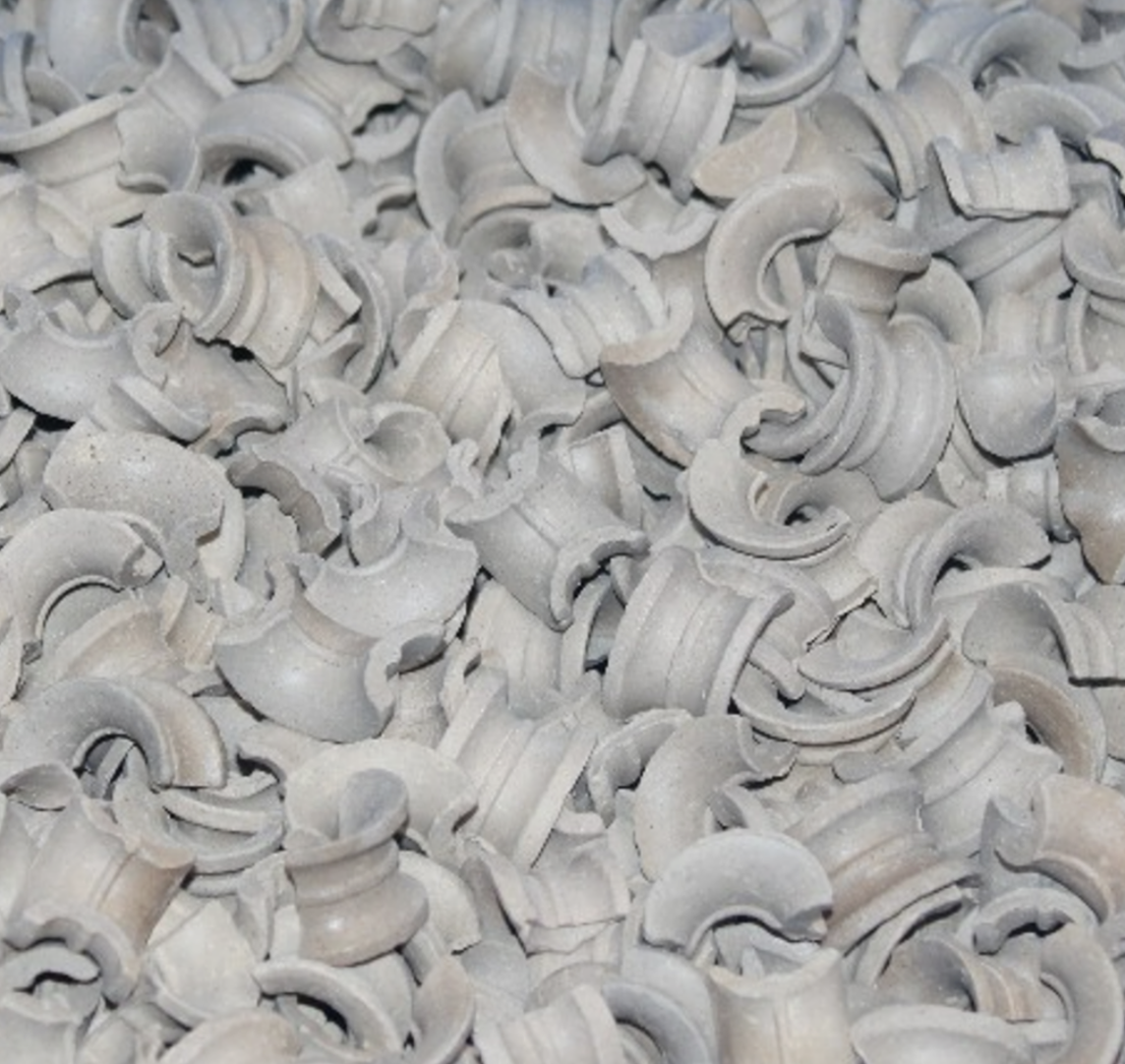
S-Cube Mass Transfer Pvt. Ltd. (SCM) manufactures Ceramic Random Packings engineered for thermal and chemical stability in aggressive service conditions. These packings provide efficient thin-film formation promoting superior wetting and liquid-vapour interaction with minimal liquid holdup.
Available Ceramic Packing Types
- Geometry optimized for enhanced liquid-gas distribution.
- Typical surface properties ensure high chemical resistance across acid gas absorption, chlorination, and flue gas desulfurization processes.
- Maintains industry-standard performance in various applications such as distillation, absorption, and stripping.
- Offers high capacity with low pressure drop due to optimized void fraction and surface area balance.
- Widely accepted in chemical, petrochemical, and pharmaceutical process industries.
- Cylindrical geometry with equal height and diameter (L/D = 1).
- Ideal for high-temperature applications and aggressive chemical environments.
- Provides reliable performance in distillation, absorption, stripping, and scrubbing columns.
- Simplistic design ensures robust mechanical strength and chemical stability under continuous operation.
FAQs
Non-metallic random packings are available in various materials including ceramic (for high temperature and highly corrosive applications), plastic (PP, PVC, PTFE for chemical resistance), and other specialized polymers.
Use non-metallic random packing when dealing with highly corrosive chemicals, aggressive environments, applications requiring chemical purity, or when metal packings would corrode or contaminate the process.
Ceramic packings offer superior temperature resistance and are ideal for high-temperature corrosive applications. Plastic packings are lightweight, easier to handle, and suitable for moderate temperature applications with excellent chemical resistance.
Ceramic random packings can handle very high temperatures (up to 1000°C+), while plastic packings have temperature limitations depending on the material (typically 80-150°C for most plastics, higher for PTFE).
Non-metallic random packings are generally more cost-effective and easier to install than structured packing. They offer good performance for corrosive applications, though structured packing typically provides higher efficiency and lower pressure drop.
Still have questions?
Can't find the answer you're looking for? Please chat to our friendly team.